Showing posts with label UNESCO World Heritage Sites. Show all posts

Sunday, August 7, 2016

The Best of Tallin


Tallin's Old Town is one of the best preserved and intact medieval cities in Europe, we are told; and it's listed as a UNESCO World Heritage Site.

It reminds me a bit of Czesky Kromlov in Austria, one of Rick Steve's "hidden gems"; with it's tiny winding cobbled streets and picturesque city square.  Of course.  Every city back then had a city square.


We have driven to / or by some of the major historical sites, like this once-winter-palace, which now houses their governmental and officiant offices.


The grounds and nearby park are quite lovely.


And this smallish, unassuming building where Peter the Great would come to stay with his wife Catherine the 1st.  It still houses some original furnishings from back-in-the-day, I  was quite surprised they haven't been sacked from here long ago.


This overlook provides us with a view of the town, and the lay of the land.  They've done a good job of not "building over" their heritage.   Not to be said about every Old Town, for sure.

Now we are dropped at Old Town itself, and we will meander on foot from here.  I'm appreciative that the weather is nice, we have a sunny day to stroll as opposed to hauling umbrella's around.


                    It's old ~ 


                                It's quaint ~ 


It's charming, with all it's old wooden shutters and heavy doors.


It's just the sort of place we would love to spend a day or  two just sniffing around the nooks and cranny's.  But, alas, we only have a few hours.  


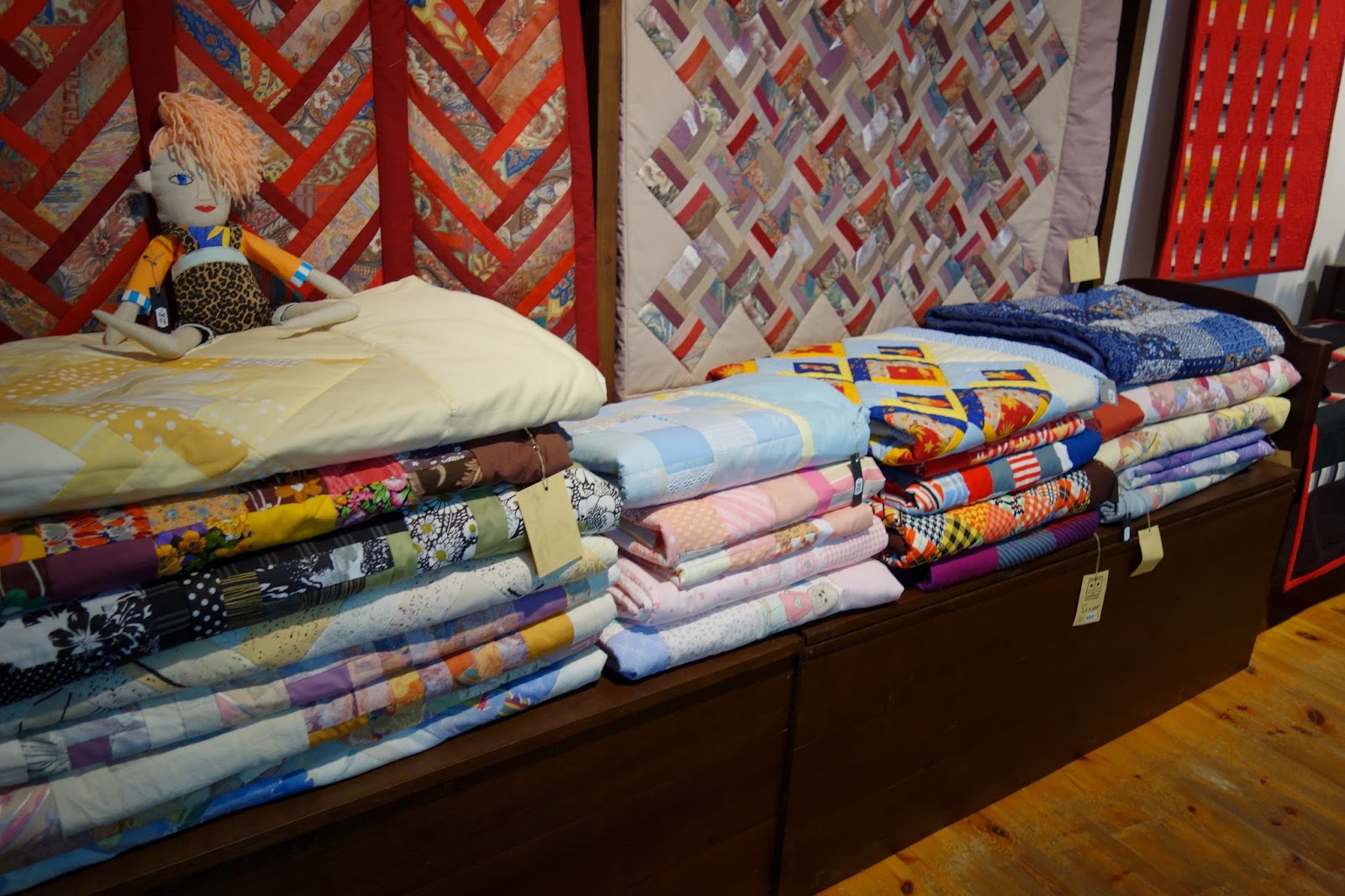
We visit some shops where hand-made goods are made and sold.
Where colorful threads and yarns 


Are turned into colorful quilts and dolls.


I spot an apothecary ~ I visited one in Beijing, so I'm interested to take a peek inside.  Especially since it's been here since 1422!


Plus -- I need Zyrtec!   Somewhere along the way I have lost the brand new bottle that I needed to get through the trip.  My allergies are severe enough that I cannot live a single day without Zyrtec, it seems.  And I'm so grateful!  She speaks English, and she has Zyrtec-- I'm saved!  


We stop at a very unusual church.  


Lutheran, this one, very dark inside, with old family crests nearly obliterating the walls.   Sort of foreboding, if you ask me.  I do love their version of the church pews, though.  Chest high compartments contain the pews, with a door on each end.  I guess once you're there, they don't want you to get away so easily.  We saw this style frequently throughout Northern Europe, but this was a first for me.


Outside you can get your snacks from the "Gourmet Monk", whomever that might be; most of which were roasted nuts of various types. 
  

Every medieval town has it's castle........however this one's not open to the public.  Unless you count the souvenir shop.  
Which I do not.


      Super crowded with all those pesky cruiseliners.  
        I hate contributing to this crush of tourists.  
It's just not our style.


Still, it's one that one can be charmed should they choose to be.
So I choose to be.


Little shops down in deep basements with steep staircases.  
Where you must Mind Your Head!

Glass blowers and painters and knit shops.


We stop for a sample of the local specialty liqueur (sweet dessert wine).  I have enjoyed trying the Lemon Cello of the Imalfi Coast, the Green Apple Grappa of rural Tuscany, the different regional Saki's in the different regions of Japan (surprisingly different from each other); even the Cobra whiskey in Laos (yes, cured with an actual cobra -- or scorpion, if you prefer).  So I must sample the Estonian liqueur,  (especially 'cause I missed the food in this county!)


It's totally lovely.  Just wonderful.  A little sweet, a little hint of vanilla.  I want to take a bottle home.  But of course there are strict liquor restrictions and tariffs aboard the cruisline.  Of course.


And, I'm dismayed, as always, to see how willing we are to share our obscenely high obesity statistics with the rest of the world.  


Finally, we are "released" for some "free time"  in the city square.  

I feel like I might be in kindergarten.  Is it recess time now??? 


The guide gives us a whole 45 minutes on our own.   Then takes the next 15 minutes to explain what type of food each and every restaurant on the square is serving.  

What we absolutely know, once we've escaped her grasp, is that we will not have a chance to try any of it.  I am totally peeved.  Just ask Mr. C.   My one day in Estonia, I do not get to try Estonian food.  Tour groups just frustrate the heck out of me.   


Now, our day in Tallin has ended, and we are being shuttled (herded?) back to the boat.  Skipping the park with this lovely statue, an angel guarding the coastline of Estonia.  I'm disappointed I did not have the chance to get acquainted, I think she might be a kindred spirit.  But now I will never know for sure.

Sunday, July 17, 2016

Tallinn, Estonia

If only we'd seen this little midevil town outside of a cruise day.......but, oh wait!   We're the cruisers this time......


I'd never heard of Tallinn, Estonia before this trip.  I could not have told you where Estonia was on a map.  But that's the joy of travel, yes?  Sometimes you end up somewhere new and exciting.


Estonia is strategically placed in the Baltic Sea to make it important to sea trade and, particularly, to Russia's sea trade.   We're en route to St. Petersburg on this Baltic Cruise, so Tallinn is a natural stopover.  At least the cruiselines think so.


We are taking a tour here -- primarily because we need to take one in Russia (it's required -- if you don't have a Russian visa, then you must be accompanied by someone who does); and we got a discount by using the same tour company in multiple locations.

Also, something to think about:  Sometimes these cruise ships come into port, but are still miles from town -- as in, too far to walk.  Then the options are 1) Expensive taxi; 2) Expensive shuttle; or 3)  A tour group that will pick you up and return you to the dock, all included in your tour package.

We normally like to explore on our own, but there are definitely advantages both ways.
  • On our own we can pick and choose what we'd like to see. 'Cause not all the top sights appeal to us.                         
  • On a tour, they pick what you get to stop and see; and sometimes, I believe it's based on where they can park that dang (huge) tour bus.  
*****
  • On our own, we can linger or breeze through as we wish.  
  • On a tour, you are locked in to their time frame, for  better or for worse.  
*****              
  • On our own, we don't always get all the history or background; 
  • While on a tour, you get a lot more info about what you're seeing (albeit sometimes you are just driving by); and you may or may or may not care what year each and every single building was built.  Just sayin'. On the other hand, you will usually get some lifestyle insights that you might not otherwise be privy to.  

Tallin is listed as a UNESCO site, and they are proud of earning that distinction.  It's a city of 450,000; but they represent 1/3 of the entire countries population.    Something they are also proud of.


We learn that the country is primarily Lutheran, but we stop at this gorgeous Russian Orthodox Church.  Tallinn has a confusing history, being dominated by several other countries at various times, including Denmark, Germany, and Russia (and there might be more, I couldn't write that fast).  Hence the Russian Orthodox Church.  We've been enthralled by many a church and cathedral in our travels; but this is my first visit to an Orthodox Church.  And it's very different.  No photo's allowed inside, unfortunately. Some were cheating on this, but I usually try to follow the rules.  I said usually.


We learned that the cross on an Orthodox Church is different, for one thing.  It has 6 points instead of 4, if you'll notice.  And the anchor on the bottom (it's not a half-moon) also sets it apart.   


The imprint of Jesus comes from a story about Jesus passing by the home of a merchant who was ill, and He stopped to heal him.  When the grateful merchant wiped his face with a ??? piece of linen, the imprint of Jesus' face
 miraculously appeared.   This mirrors the Christian belief that the imprint of Jesus body was retained in his burial shroud. 

And the bells, they believe, are a healing sound.  Not the same as those churches that play a recorded version.  I like the sound of that.  Pun intended.


We see the National flag of blue, black, and white, and we learn that the blue symbolizes the sea; the black symbolizes both salt (which was a highly prized commodity) and tragedy (the wars by which they bought their freedom); and the white symbolizes hope.  The hope of a future filled with trade from the sea, salt for the table, and the freedom that was so dearly purchased.  I like this, too.


Their tallest building is the spire of St. Olaf (Oliver in English); and no other "skyscraper" is allowed to supersede it in height.  Probably helpful in obtaining the UNESCO status, as their old town remains visible and distinctive, not getting swallowed up by "progress".

Under Soviet rule, everyone's salary was the same.  I know, this still just weirds me out as an American.  Doesn't matter how hard you work, you still get the same as the guy next to you who might be a total sloth.  100 Rubels she tells us. Whether you're a doctor or a street sweeper.  

Now they're on the Euro, of course, and the average salary here is 1,000 Euro's per month.  That's about $1,100 American.  


Their public trams are only two year's old, and are free transportation to their citizens.   If on our own, this is ordinarily something that we would try out, both for the convenience of transport and for the experience of "getting about" as a dweller of that city.


We stop at this park, which is known for it's live music concert, held here once every five years.  It's a huge stage, and the acoustics are amazing.  No microphones are used. 


It will hold as many as 35,000 singers (at one time!), giving a huge choir performance; as well as individual group performances in traditional costumes singing historical songs that are core to their nationality. (this is weak!)

Traffic is closed throughout the city while these performers march their way through the streets to the park.


I love this --100 oak trees planted here on the one-hundredth anniversary of something (I don't remember).  
It's a lovely thought, though, and is a living, growing memorial that I found quite dramatic.  At least in the springtime when it's all green.


Now we head to Old Town ~ always my favorite, no matter what the city.  I've discovered that I really like ancient stuff, I like how it feels.  It feels so.....I don't know, ancient I guess.  We don't have ancient in America, you know.  We're such a baby country compared to the rest of the world. 


Here's where both our cruise and our tour bite us in the butt.  We're not the only cruise ship in port.  There are not two, not three, but four -- count them -- four gigantic cruise ships in port for this little tiny town.  (Just as a point of perspective, our Celebrity ship has 2700 (+) guests, plus 1200 (+) crew).  Times four.  Yikes.  We have swallowed this poor little town alive.  


And our tour guide, though fairly good, has stopped to tell us about the age and architecture of every single building, which has left us almost no time to actually enjoy the town square.  Once we arrive, she gives us 20 minutes of "free time".  I feel like I'm in kindergarten.  She took much of that time to explain each of the (many many) restaurants surrounding the square, which left us no time to actually sit down and enjoy a lunch of traditional Estonian food.  Whatever that is.  I will probably never know, now.

So, while we probably would have loved this little town had we been on our own, we did not so much love having to shove our way elbow-to-elbow with some 4 or 5 thousand other cruisers.  Yuck.


A little more scenery as we are "escorted" back to the bus.  Missing the castle, except for just a pass-through.


Missing the church I really wanted to explore.  (It was just a walk-by).


I'm not the best tour group material, me thinks.  


Wednesday, April 27, 2016

Shirakawa-go, Japan


There are always a million opportunities when you are traveling.  Stay on track or wander a little?  Design a schedule to see everything you think you want to see, while you're sitting in the comfort of your American home with all it's luxuries; or leave some wiggle room to chase those "yet unknowns" that pop up once you're there, and you're immersed in the culture of the present?

We land somewhere in the middle.  We structure our visit to include the "must do's", and schedule plenty of time for that.  Plus we add a little room for adventure, the chance to wander off (or run off!) to see something that we were previously unaware of.


Shirakawa-go (Sheer-a-cow-a-go) is one of those in the latter category.  It's a really unique little village in Japan, between our (scheduled) stops @ Takayama and Kanazawa. It's off the beaten trail, not exactly a day trip, but certainly not worth an overnight stay.

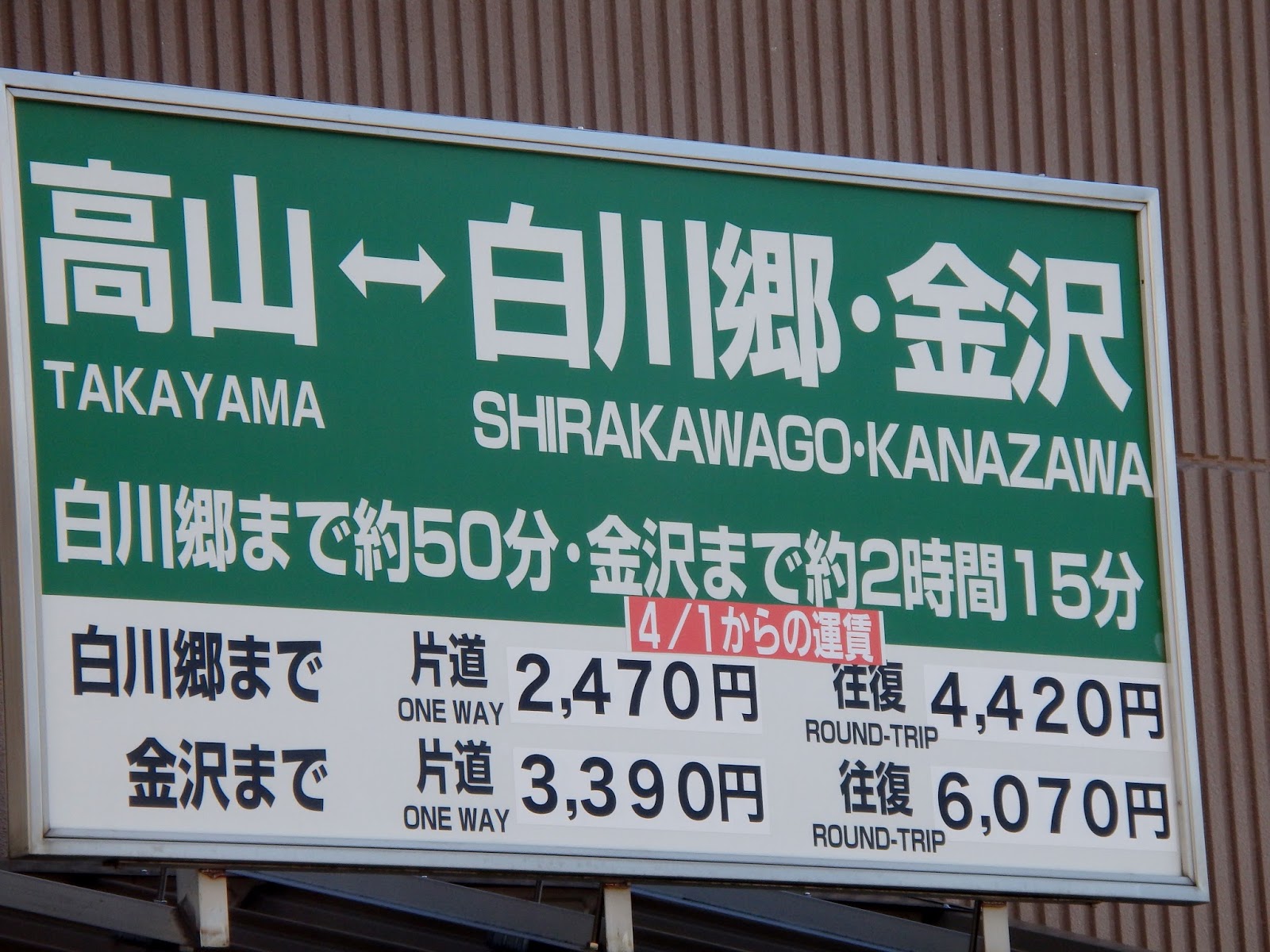
So of course there's an adventure associated with getting there.  We traveled by train from to Takayama, and noticed upon disembarking that the bus and train depot are one-in-the-same.  How handy for us!

Because we need to take the bus to Shirakawa-go.  And we can't stay there, even if we were inclined to, 'cause we already have a hotel booked @ our next destination.  So we need to be sure that we can get from here to there, but also, once there, to our hotel, clear over yonder.


We are staying just a block away, so we roll our luggage down to the station ahead of schedule, to buy a ticket (in a foreign language) and find the right bus (in a foreign language) with lots of other people (who are also speaking a foreign language). 


It's odd that, as we are boarding,there's a local actually counting us as we get on the bus.  They mystery doesn't last long, though.  Once all the seats are full, people keep getting on board -- and they fold down a special "isle seat",  all the way from the back of the bus to the front of the bus. I must say, I've never seen the like. This is decidedly different than back home in the US of A.  And I won't deny feeling just a little claustrophobic about this whole deal........


Arriving at Shirakawa-go, we grab our luggage from the underneath storage of the bus, and sprint to the lockers that we read are available for that purpose.  

They seemed to be both limited and, subsequently, 
in great demand, so we were grateful that we weren't stuck hauling them around for the remainder of the day -- kudos, once again, to Mr. C and his research.


Then we lightly trek across 
the (ancient) suspension bridge 
to the village itself. 


 And from there, it's a step back in time.  
Back to the 11th century, to be precise.


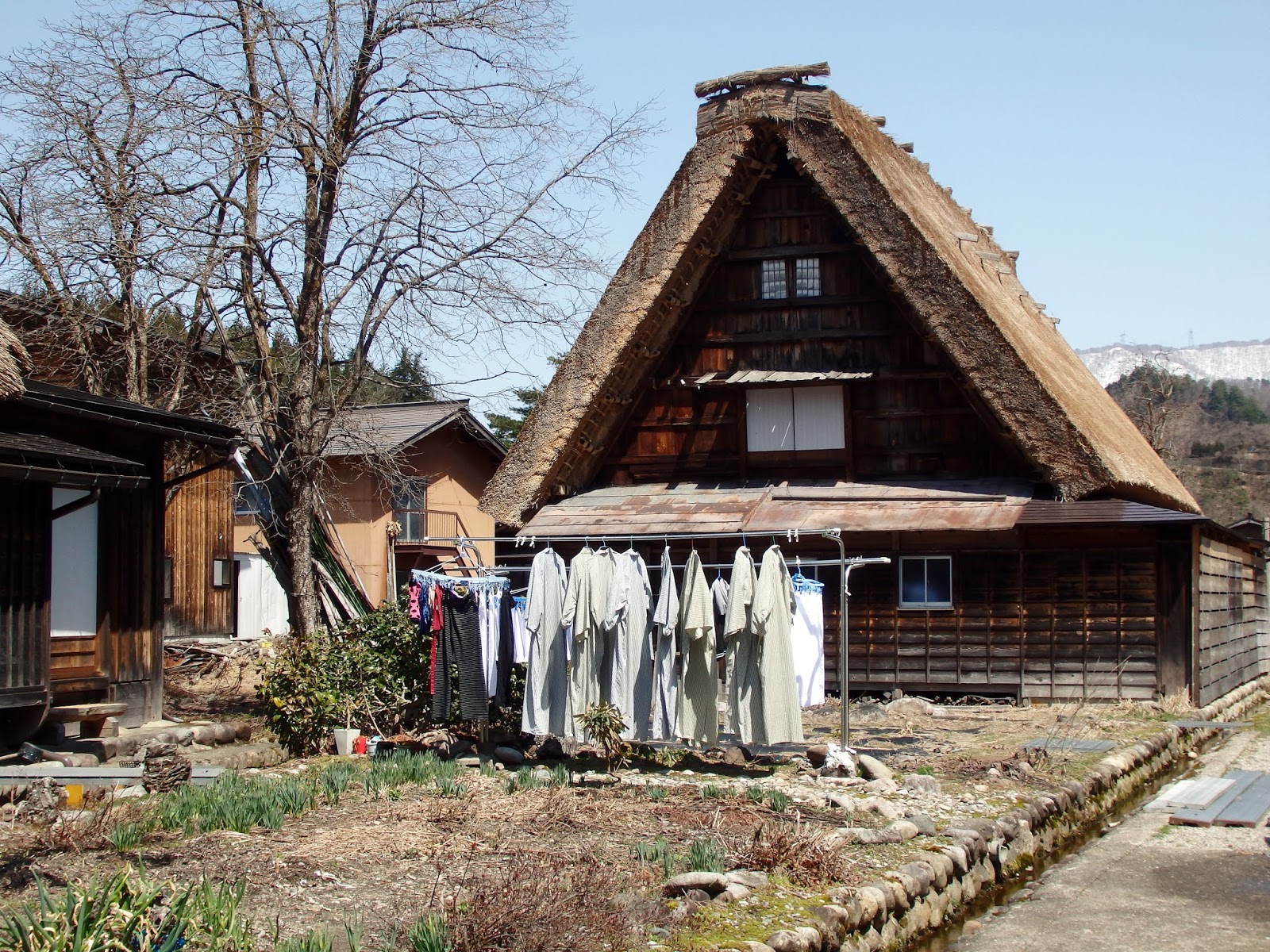
This village still builds and lives in the thatched roof houses of yesteryear.  The houses are constructed in an architectural style known as "gassho-zuriki" (合掌造り) 
interpreted as "prayer-hands construction", and is characterized by a thatched and steeply slanting roof that  resembles two hands in posed in prayer.  The design is exceptionally strong and, combined with the unique properties of the roof's thatching, allows these houses to withstand and shed the heavy weight of the regions notoriously deep snowfalls in wintertime.

Me?  I just think they're adorable.


There may (or may not) be indoor plumbing, but there's also a fresh water trough running throughout -- perhaps this is for irrigation.   The whole thing sort of reminded me of our American Amish, living (by choice) more humbly than might be necessary.  


But I'm very glad that we are "very glad welcome" ; especially if you "be on one's right".


We think this must be a "Ryokan" ~ judging from the laundry on the line.  Which means that you could stay overnight here, if you want to get the full experience, in the traditional Japanese style.  I think it's a lovely village to visit, but......I'm still unsure about the plumbing situation, so color me hesitant.....


So the big deal is this:  It's not the lifestyle, or the remote mountainside existence.  The big deal is the houses, and how they're constructed.  From the land, from the earth, from materials-at-hand to withstand these mountain winters, and unique in all the world.  

The houses face north and south, to minimize wind resistance  They stand in a specific direction to adjust the amount of sun in order to keep the room cool in the summer and warm in the winter.  


Well, I would say cool(er) and warm(er).  'Cause while the roofs might be thick and cozy, remember that the walls are still (mostly) paper thin.  As in actual paper.  My feet were freezing just having to kick off our shoes to tour these places.  Icicles.  You all know that I do better in flip-flops.


While most still live their day-to-day lives like this, on Tatami mats, with a fire in the hearth there are some who graciously open their homes to visitors like us, in order to see and fully appreciate why, to preserve this, is so wonderful.


We enter the house, and then climb from floor-to-floor (normally at least three floors)  on ladders like this.  


While the lower levels of the house(s) were meant for the family to live, the upper level(s) were meant for storage and industry.  Sericulture.  The silkworm industry, to be exact.  Yup. Because there's an abundance of Mulberry trees, and thus Mulberry leaves here, this industry thrived in this remote and harsh region.  It seems that silkworm larvae love to feed on Mulberry leaves.  Who knew???  So most every home raised them in their attics, and harvested their wonderful silk to sell.


You really must look at how the beams are cast.  Huge logs are set and bound with ??   Ropes and ??  There are no nails or spikes.  

It's for sure not how we would do it in the US.  
Me & Mr. Construction C are spell bound by all this.


Of course there's a temple, and a shrine.  Even they have their thick winter cap of sheathes.


I may not know know what it all means, 
but I appreciate the beauty of it.  


It's cold.  Cold enough for an igloo.  


Cold enough for "Igloo gloves" jokes.

I'm assuming that this is supposed to be funny.


Here they are drying the sheaths 
that will become the thatched roofs of the future.


It's so picturesque.  


These thatched roofs are a marvel, and are unique to this type of architecture, which is unique to Japan.  At the time of re-thatching (basically, it's re-roofing), all the old sheaths are first stripped from the roof.  They are sorted, and those that can be are re-used.  


Then, teams of men boost the new sheaths up to those on the roof, who pass them up and up and up; and the entire roof is re-covered.  And then they repeat this step.  And then they repeat it again.  


It's not complete until 5 layers of thatching are laid, and the peak is covered and interwoven with the roof.  No matter what the weather, no matter if it's rain or shine, the entire process must be (and is) completed within a single day.  The entire village turns out for this, even the neighboring people will come volunteer their time; Indeed, is expected to, because (of course) when it's your turn you're gonna' want the same.  It reminds me very much of our Amish barn-raisings, yes?  There's a term for it, in Japanese it's called YUI.

I read some fascinating information while we were on-site, about how many men it takes (it's a lot), what the cost equates to in current times (it's astronomical);  but try as I might I've not been able to find all the same facts on-line. 

If you're interested, though, by all means pursue it, it's terribly interesting. 


Finally, it's time for a little lunch.  We've learned that one of the "safest" things to order in Japan is an Udon noodle bowl.  Soba noodles in an excellent, rich broth, sometimes with pork or beef or chicken; sometimes with veggies; sometimes with mystery ingredients to us Westerners.  
This one was excellent.

(I like that the "amazake" is served "onky in winter".)


  This tame lunch seems all the more special once we saw our neighboring Japanese diners being served something else.  Something that was alive.  Insects???  Something with wings.  Lots and lots of wings.  That were beating furtively against the heat of ???  whatever they were being served upon, that was (evidently) hot enough to silence those beating wings, after a bit.  Wish I'd caught a video clip.  But, sometimes, it's just awkward to explain why you would be videoing somebody else's lunch. 
Even if it is still alive and trying to escape.  Yikes.


It's time for us to catch our bus to our next destination.  

What a lovely little town, what a fascinating stroll back through time.  There's always the debate, with these little gems, that we (meaning the tourists) just ruin it by coming to visit.  I don't know, perhaps we do.  But at the same time, I do so appreciate those that open their hearts and homes and lifestyles to those of us who are interested in learning about their life and their culture.  

I know I would, were the sandal on the other foot.